The Hip Hinge
Think about the last time you opened a door. It swung effortlessly on a hinge—moving in one smooth, predictable direction.
Our bodies have hinge joints too. Your elbows, knees, fingers, ankles, and toes all bend and straighten in much the same way.
But your hips?
They're a whole different story. Lets start with an experiment, move a joints in your body, maybe your finger. Go ahead, move to feel how your hinge joints work. You’ll notice a bending, that is movement in one plane (front and back), much like that of door hinge enabling a door to open and close. This motion is a bending (flexion or shortening of the angle) and straightening (extension or lengthening the angle).

Our bodies biggest joint player for hinging resides in the hips. “Its all in the Hips.” It flex’s (so you can sit) and extend’s (so you can stand) buuuut it also, abducts, adducts, and rotates both internally and externally. Having the ability to move in all those various planes of motion (sagital, frontal and transverse) is special, so special it has a name, multiaxial joint. Now, there is only one other part of the body that can do that….. can you think of it? If you guessed the shoulder then you get a 5 point high-five!
Being able to hinge at the hips is nothing new, heck most of us are locked into a flexion for 8+ hours of the day when seated at a desk for work, or at a table for meals, or when riding in a car.
The Problem: Our standard day to day actions only manipulate the hips in that set range; flexion and extension. The problem is the hips are meant to move more freely than that! When was the last time you sashayed side to side? I’m betting its been a while. How about hula hooped? Decades? When we don’t engage in motions that are outside the standard box or cookie cutter action, we create a movement deficit. Rather there is a” lack of exposure” to positions and ranges that your body is 1. capable and 2. needs. Human movement can be broken down into a handful of foundational patterns: squat, hinge, push, pull, carry, rotate, and gait (walking). The better we maintain these patterns throughout life, the easier everyday tasks become. Cuz when we fail to provide our bodies with a variety of movement patterns, the tissues will become stiff and weak (psst - we want them supple, adaptable and with full control).
Most of our daily activities—and even many exercise routines—primarily challenge the hips in just one plane of motion. The result? The muscles responsible for rotating, stabilizing, and moving the hip sideways often don't receive the same attention. So that means the other movement directions go undertrained, under exposed and under performing. This is when injuries happen. When our bodies are not accustomed to a movement, it can falter under the pressure we are asking it to do. Injuries rarely happen because one movement is "bad." They happen when our bodies are asked to perform movements they haven't practiced.
So what can we do? Focus your training on gaining full joint motion and control.
How? By exploring more movements. By finding your end ranges of motion and then working to expand those ranges. By building more control through multiple body positions and contortions. For example, lets take the basic squat, what if one foot was elevated? Would you be able to maintain full range of motion and control. Now move that elevated foot out to a 45’ angle, do you still have full range of motion, power and control? If you have tight hips the answer will likely be no.
How can you for real? Lets start by perfecting your hip hinge. Why? because the hip hinge strengthens the muscles that support the hips:
🍑 Glutes (your primary hip extensors)
🦵 Hamstrings
💪 Deep core muscles
🦴 Lower back stabilizers (especially the erector spinae)
If I asked you to bend over and pick up a laundry basket...
Would your hips move first?
Or would your back round?
Most people don't realize they're bending from the wrong place until something hurts.
Often, what I see is people will facilitate the bend with their lower back instead of bending at the hip joint (the place that makes a hinge).
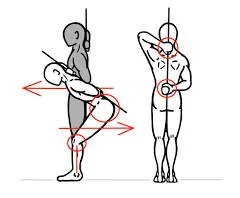
The hip hinge is a foundational movement pattern meaning you see it in everyday lifting and living. It will protect your lower back, strengthen your posterior chain (glutes, hamstrings, and erector spinae), improve posture, and build core stability to prevent injury during daily tasks. [1, 2, 3]
How to Perform a Hip Hinge
Stand tall with your feet hip-width apart and a slight/very soft bend in your knees.
Brace your core and keep your spine in a neutral, straight line from head to tailbone.
Push your hips straight back as if you are trying to close a car door or tap a wall behind you with your glutes.
Allow your torso to lean forward naturally while keeping your back flat and your knees from bending further forward.
Drive your hips forward and squeeze your glutes to return to the starting upright position.
What is actually happening in your body when you hinge?
1. Your hips move backward
Instead of bending primarily through your spine or knees, your hips travel backward while your torso leans forward.
This movement loads the powerful muscles on the back side of your body, often called the posterior chain.
The main muscles at work include:
Gluteus maximus – controls the descent and powerfully extends the hips as you stand.
Hamstrings – lengthen under tension as your hips move back and help extend the hips on the way up.
Gluteus medius – stabilizes the pelvis and prevents excessive side-to-side movement.
Deep core muscles (especially the transverse abdominis and obliques) – brace the spine and create stability throughout the movement.
Spinal erectors – keep the spine long and resist rounding while supporting your torso.
2. Your knees bend slightly
Unlike a squat, the knees only bend enough to allow the hips to move freely backward.
Your shins stay nearly vertical, keeping the emphasis on the glutes and hamstrings instead of shifting it to the quadriceps.
Your feet remain firmly planted, with pressure distributed through the entire foot—especially the heel and midfoot—to create a stable base.
3. Your spine stays neutral
Your back should maintain its natural curves from your neck to your pelvis.
Rather than rounding or over-arching, your core creates stiffness so your spine moves as one solid unit while your hips provide the motion.
Think of your torso as a strong plank that simply tips forward from the hips.
Why does this matter?
The hip hinge isn't just another exercise you'll learn in the gym. It's the movement that lets you pick up your kids without hesitation. It's what allows you to spend an afternoon gardening without your back reminding you about it the next morning. It's the confidence to carry a heavy bag of mulch, climb a mountain trail, shovel snow after a storm, or simply tie your shoes with ease.
Those moments don't feel extraordinary while you're living them—but losing them certainly does.
That's why I believe strength training shouldn't just be about burning calories or building muscle, its preparing you for life.
The stronger your movement foundation becomes, the more freedom you gain to say yes to adventures, hobbies, travel, and the people you love.
That's exactly why I'm kicking off my Strength for Life Series: Hip Hinge & Posterior Power.
Over five weeks we'll improve mobility, build strength, increase confidence, and teach your body to move the way it was designed to move.
Because the goal isn't simply to exercise.
The goal is to stay capable—for life.