Resistance Bands - Small but Mighty 💪
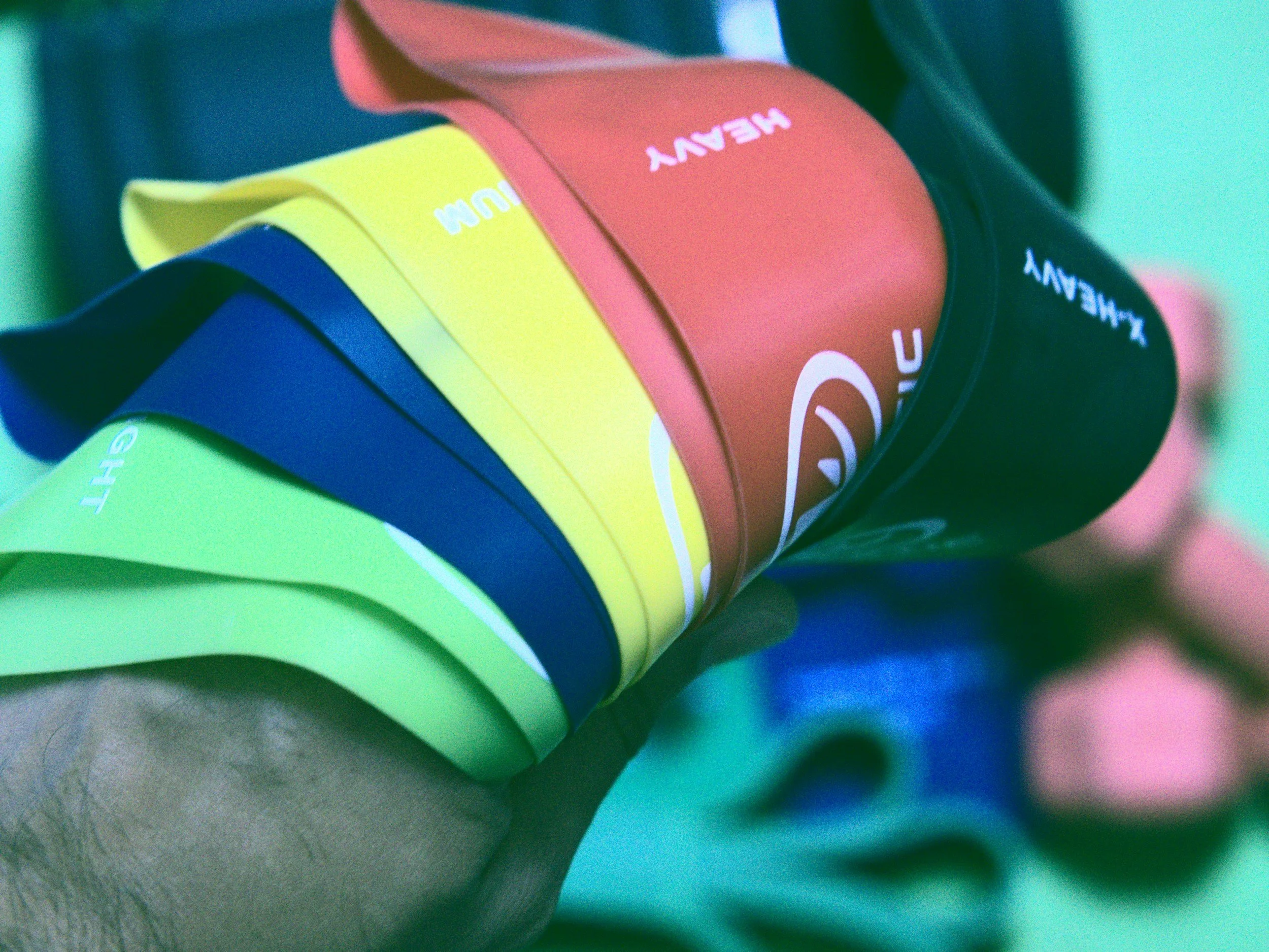
The more I progress in my fitness education, the more appreciation I have for simple and effective tools. Whether its a movement pattern that targets all the major muscle groups, like the RDL Hip Hinge or a movement progression that leads to complete muscle activation during training sessions I’m a sucker for tried and true techniques and tools. One such tool that I have been coming back to a lot recenlty is the Resistance Bands.
And if you’ve had any experience with them lately you’ll agree, you love to hate them because of how much your muscles ache after your done using them.
Why? because they are tools of torture? NO! Just smart human ingenuity. You work multiple phases of muscle contraction simultaneously! You are stabalizing in the joint while also moving away from said joint. Maybe we need to break it down a bit first.
When using our muscles there are 3 types of contraction. Isometric and isotonic concentric or eccentric.
Isometric - The muscle generates tension without changing its overall length, and the joint does not move.
example: Holding a plank or wall sit.
Isotonic - Muscles contract and change length—either shortening (concentric) or lengthening (eccentric)—while moving a joint through space.
Concentric example: Lifting a dumbbell upward during a bicep curl or rising from a chair. It’s the “Pump” in pump it up.
Eccentric example: Slowly lowering a dumbbell back down or walking down a flight of stairs. I like to say “control the negative”
Within various strengthening exercises you’ll go though various stages of muscle contraction.
The Squat: Standing up is the lifting (concentric) phase where muscles shorten. Holding the squat at the bottom (isometric). Lowering your hips back down toward the floor is the eccentric (lengthening) phase.
The Bicep Curl: Curling the weight up to your shoulder shortens the bicep (concentric). Pausing midway would offer a Isometric. Slowly lowering the weight back down to your side is the eccentric movement.
The Push-Up: Pushing your body away from the floor is the concentric up phase, while slowly lowering your chest back to the ground is the eccentric phase. And if you held your body off the ground for a couple moments that’s the isometric.
Now let’s think about what happens when we add resistance bands to these movements.
A resistance band creates tension as it stretches. The farther you stretch it, the more resistance it provides. That means your muscles aren't simply moving a weight from Point A to Point B—they're constantly responding to changing tension and working to both produce force and control force throughout the movement.
Think about pulling a rubber band apart. You have to exert force to stretch it, but you also can't just let it snap back. You have to control the release as the band returns toward its resting length.
Your muscles do something similar.
Take a banded bicep curl. As you curl the band upward, your biceps are shortening under tension—that's the concentric phase. As you slowly lower your hands and allow the band to pull back toward its starting position, your biceps are still working, but now they're lengthening under tension. That's the eccentric phase.
And that eccentric control is a big part of the magic.
We often think the "work" is happening when we're lifting or pushing, but your muscles are also working when they're braking, stabilizing, and controlling movement. In fact, eccentric work can create a significant training stimulus, which is one reason you may feel those muscles the next day after a good resistance-band workout.
Bands also introduce another interesting element: the resistance changes throughout the range of motion. Unlike a dumbbell, where the load itself stays the same, a band generally becomes more challenging as you stretch it farther. Your body has to continually adjust to that changing tension while maintaining control of the joint and the movement.
So, rather than being a lightweight alternative to "real" weights, resistance bands are actually a pretty clever training tool.
And they're incredibly practical.
Resistance bands don’t weigh much. They're small and pliable—you can roll them up, fold them, or toss them in a bag. And they're relatively inexpensive compared with purchasing a collection of dumbbells. You could get a 40lb dumbbell will run you $41 bucks (that’s just for one, not the set), while you could also get 35-85 lbs of resistance in band form in a set of 5 for $15! .
That means you can keep them in your car, suitcase, home office, or workout bag and have a strength-training tool ready whenever you need it.
No weight rack. No giant piece of equipment. No dedicated home gym required. Just a band, a little space, and a body willing to work.
Want to give resistance bands a try?
If you're curious about incorporating resistance bands into your own workouts, I've got you covered! I've put together a couple of resistance-band workouts over on my YouTube channel to help you get started.
Whether you're traveling, working out at home, or simply want to add a little variety to your strength routine, grab a band and give one a try. You might be surprised by just how challenging—and effective—such a simple little piece of equipment can be!
Here are a couple to get you started and I’m posting more!
Head over to my YouTube channel, pick a workout, and let's get moving!
#Thetakeaways - You don't need a room full of equipment to build strength. You need resistance, consistency, and a body willing to work.